

Choosing a full-time preschool in Livermore involves more than just finding a program that fits your child’s schedule. You want to know what your child will actually experience throughout the day. Will learning be organized without feeling overly academic? Will your child have opportunities to play, explore, move, create, and build relationships? Most importantly, will the daily routine help your child feel secure while developing skills for kindergarten and beyond?
In a well-structured full-time preschool program, teachers use the entire day as an opportunity for learning. Activities are planned around your child’s developmental stage, interests, and individual needs. A morning circle can support communication and listening skills. A hands-on activity can introduce early math or science concepts. Outdoor play can strengthen physical development and cooperation. Even transitions between activities can teach independence, patience, and classroom routines.
For Livermore families looking for full-day preschool care, this consistent structure can provide both educational value and dependable daytime care. Instead of separating “learning time” from the rest of the day, quality preschool programs create learning opportunities throughout the daily schedule.
Key Takeaways
- A full-time preschool schedule can combine structured learning, guided play, outdoor activities, meals, rest, and social development.
- Teachers typically use predictable routines to help children understand what happens next and feel comfortable in the classroom.
- Preschool learning focuses on age-appropriate development rather than formal academic instruction alone.
- Activities can support language, early literacy, mathematics, science, motor skills, creativity, social-emotional development, and independence.
- Consistent attendance gives your child more opportunities to build relationships, practice routines, and participate in ongoing classroom activities.
- A strong preschool program should balance teacher guidance with opportunities for children to make choices and explore independently.
How Teachers Build Structure Into A Full-Time Preschool Day
A full-time preschool schedule gives teachers a longer portion of the weekday in which to organize learning, play, meals, rest, outdoor experiences, and transitions across the day. The goal is not to fill every hour with formal instruction. Instead, teachers can use a predictable routine while providing age-appropriate opportunities for children to explore, interact, practice skills, and participate in guided activities.
Teachers plan the daily schedule so that active periods, quieter experiences, social activities, meals, outdoor time, and rest fit together in a developmentally appropriate way. The exact schedule can vary by preschool, classroom, age group, and licensing requirements, but the underlying goal remains similar: give your child a predictable day with enough flexibility to respond to individual needs.
Predictable Routines Help Children Know What To Expect
Young children can benefit from familiar routines because repeated experiences help them understand what is expected during the day. A preschool may use consistent arrival procedures, cleanup routines, meal times, outdoor periods, rest or quiet time, and transitions between activities. Teachers can reinforce these routines with verbal reminders, songs, visual cues, or demonstrations appropriate to the children's ages and abilities.
Teachers may use visual schedules, songs, verbal reminders, or simple transition cues to help children move between activities. Over time, your child can begin anticipating these transitions without needing constant adult direction.
This consistency can also support independence. Instead of an adult completing every task, your child may be encouraged to put belongings away, wash hands, clean up materials, choose an activity, or prepare for the next part of the day.
Structured Learning Is Balanced With Play
Play is a major part of how young children learn. In preschool, teachers can use play to reinforce concepts that might otherwise seem abstract.
For example, a pretend grocery store can introduce counting, sorting, communication, and social interaction. Building with blocks can encourage problem-solving, spatial awareness, and early engineering concepts. A classroom art project can strengthen fine motor skills while giving children opportunities to make choices and express ideas.
Teachers provide structure by selecting appropriate materials, setting up learning environments, asking questions, and observing how children interact with activities. Your child still has opportunities to explore rather than simply following instructions from beginning to end.
Teachers Plan For Different Developmental Areas
California's Preschool/Transitional Kindergarten Learning Foundations address multiple areas of children's development, including approaches to learning, social-emotional development, language and literacy, mathematics, science, physical development, health, history-social science, and visual and performing arts. Language and literacy development also includes foundational language development and English language development. Teachers can address these areas through classroom activities, conversations, play, routines, movement, and hands-on experiences.
Teachers may plan activities that support:
- Language and communication
- Early literacy
- Early mathematics
- Science and discovery
- Fine and gross motor development
- Social-emotional skills
- Creativity and self-expression
- Self-help and independence
- Cooperation and classroom participation
This broad approach matters because kindergarten readiness involves more than knowing letters or numbers. Your child also needs to communicate needs, follow routines, interact with peers, manage transitions, and participate in group activities.
What Learning Looks Like During The Preschool Day
A full-time preschool schedule allows teachers to revisit learning concepts across different parts of the day. A skill introduced during a group activity may appear again during center time, outdoor play, classroom routines, or conversations. This repeated exposure gives children opportunities to use developing skills in different situations rather than relying on a single lesson.
Morning Activities Establish The Day
Arrival and morning activities help your child transition from home to school. Teachers may greet children individually, encourage them to put away their belongings, and invite them to begin a classroom activity.
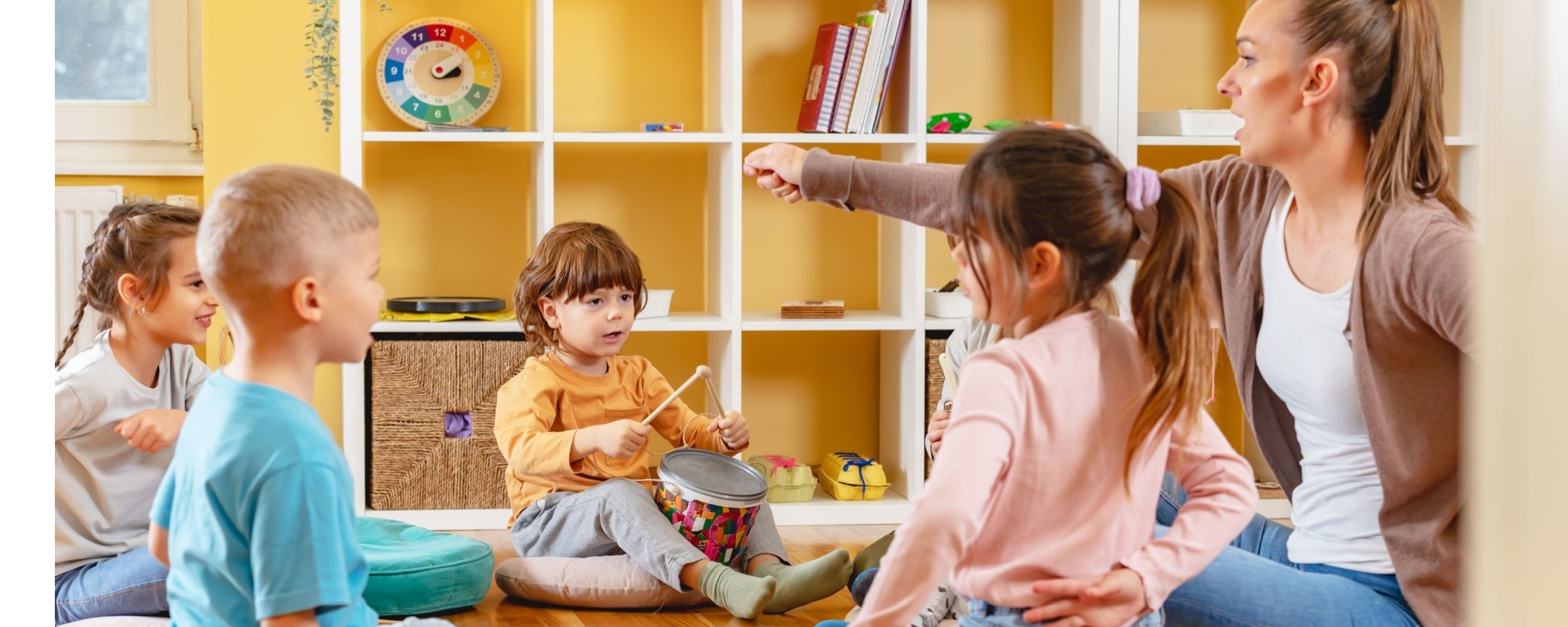
A morning meeting or circle time may follow. Depending on the age group, children might sing songs, listen to a story, discuss the day’s activities, identify weather, practice counting, or talk about a classroom topic.
These activities give children opportunities to listen, communicate, take turns, and participate in a group. They also give teachers a natural way to introduce a topic, review a familiar concept, or explain what children can expect during the day.
Hands-On Activities Make Concepts Easier To Understand
Preschool children benefit from opportunities to explore, manipulate, and experiment with age-appropriate materials. Teachers can use hands-on activities to introduce early concepts while giving children opportunities to observe, ask questions, make choices, and practice emerging skills.
For example, children might sort objects by color, shape, or size. They may count classroom materials, compare quantities, create patterns, or explore simple measurements.
Language and literacy can be incorporated through storytelling, rhyming, letter recognition, conversations, picture books, and opportunities to describe experiences.
The objective is not simply to have your child memorize information. Teachers are helping your child develop curiosity, communication, reasoning, and the ability to engage with new ideas.
Outdoor Play Supports Physical And Social Development
Outdoor play is another important part of a balanced preschool day. Running, climbing, jumping, balancing, throwing, and other physical activities help children practice gross motor skills.
Outdoor environments also create natural opportunities for social learning. Your child may need to share equipment, wait for a turn, communicate with another child, or work together during a game.
Teachers can supervise these experiences while encouraging children to make safe choices and solve age-appropriate social problems.
How Teachers Support Social-Emotional Development
Preschool is an important setting for learning how to participate in a group. Your child is not only learning colors, numbers, letters, and stories. They are also learning how to communicate, cooperate, handle frustration, and build relationships.
Teachers can intentionally incorporate these skills into daily routines rather than treating social-emotional development as a separate subject.
Children Practice Communication And Cooperation
A classroom gives your child frequent opportunities to communicate with both teachers and peers. Children may practice asking for help, expressing preferences, explaining ideas, listening to others, and participating in conversations.
Teachers can model appropriate language when children disagree or have difficulty sharing. Instead of simply solving every conflict for them, educators can guide children toward age-appropriate ways to communicate and problem-solve.
These experiences can help your child become more comfortable participating in a group environment.
Teachers Help Children Manage Transitions And Emotions
Transitions can be challenging for young children. Moving from playtime to cleanup, outdoor activities to the classroom, or lunch to rest requires your child to stop one activity and begin another.
Teachers can make these transitions more manageable by giving advance reminders, using consistent routines, and explaining what will happen next.
When a child becomes frustrated, teachers can acknowledge the emotion while helping the child identify appropriate ways to respond. These moments can become opportunities to practice self-regulation and emotional communication.
Classroom Relationships Create A Sense Of Belonging
Your child spends many hours in a full-time preschool environment, so positive relationships matter. Teachers can build trust by greeting children warmly, listening to their ideas, responding consistently, and recognizing individual interests.
Children can also develop friendships through shared activities and repeated interactions. A stable classroom environment gives them time to learn how to participate in a community.
For you as a parent, this can be one of the most meaningful benefits of choosing a full-time program. You are not simply looking for supervision during working hours. You are looking for an environment where your child can feel safe, included, and supported while learning.
How Teachers Use The Full-Day Schedule To Reinforce Learning
A full-time preschool program gives teachers time to introduce concepts, observe children's responses, and reinforce learning later. The extended schedule can also provide room for slower transitions and age-appropriate rest.
A quality program should not simply fill additional hours with more lessons. Instead, the schedule should be balanced around how young children learn and function throughout the day.
Repetition Helps Children Develop New Skills
Young children generally benefit from repeated opportunities to practice developing skills across different activities and situations. A concept introduced during a group activity may appear again during centers, play, outdoor time, or classroom routines.
For example, counting may be practiced while discussing attendance, organizing materials, playing a game, or setting up an activity. Vocabulary introduced during a story may reappear in classroom conversations.
This repetition gives your child multiple ways to encounter and use new information.
Teachers Adjust Activities Based On Observation
Preschool teachers observe how children participate in activities. They may notice that a child is ready for a more challenging counting activity or that another child needs additional support with a particular classroom routine.
Observation can help teachers adjust activities, materials, questions, and levels of support based on what they see children doing. This allows teachers to respond to differences in children's developing skills, interests, and needs rather than assuming every child will participate in the same way.
If several children show interest in animals, for example, teachers might incorporate animal books, counting activities, art projects, movement games, or science discussions into the classroom.
This approach keeps learning responsive while maintaining the overall structure of the program.
Rest And Quiet Time Are Part Of The Routine
A full-time preschool day can be demanding for a young child. Rest or quiet periods can give children an opportunity to slow down and recharge.
Depending on the program and age group, this may include naptime, quiet activities, books, puzzles, or other calm experiences.
Rest periods also provide a natural change of pace between more active portions of the day. A schedule that recognizes children's need for rest can make the entire preschool experience more manageable.
Why Consistency Matters For Your Child
Consistency can be valuable during the preschool years because children have repeated opportunities to participate in classroom routines, interact with teachers and peers, and practice developing skills. For a child attending a full-time program, these experiences occur across a larger portion of the weekday schedule. The benefit comes from the quality and consistency of those experiences, not simply from the number of hours spent in care.
However, consistency does not mean every minute has to be identical. Strong teachers can maintain familiar routines while adapting activities to the children in front of them.
Regular Attendance Builds Familiarity
When your child attends preschool regularly, familiar routines can become easier to follow. Your child may become more comfortable with where personal belongings are stored, how activities begin and end, when the class transitions outdoors, and what is expected during group activities.
Regular participation gives your child recurring opportunities to practice emerging skills and interact with familiar teachers and classmates. If your child misses preschool, teachers can help with the transition back into the classroom routine.
Repeated Interactions Strengthen Relationships
Social development takes time. Children benefit from repeated opportunities to interact with the same teachers and classmates.
Through these interactions, your child can learn how to join a group, maintain friendships, resolve small disagreements, and cooperate during shared activities.
For many families, this social continuity is an important consideration when comparing full-day preschool options in Livermore.
Consistency Supports Growing Independence
Your child can gradually take more responsibility for everyday routines when those routines are repeated.
You may see your child become more comfortable with tasks such as putting away personal items, washing hands, cleaning up after activities, choosing materials, or preparing for transitions.
Teachers can encourage this development by giving children enough time to attempt tasks themselves rather than immediately doing everything for them.
What You Should Look For In A Full-Time Preschool In Livermore
When you tour a preschool in Livermore, look beyond the classroom decorations and ask how teachers intentionally organize the day. California's preschool curriculum guidance emphasizes learning environments, routines, teacher-guided experiences, child-initiated play, and adapting curriculum to children's needs and interests. A good tour should give you enough information to understand how those principles appear in the classroom you are considering.
A strong full-time preschool should provide a thoughtful balance between planned learning and child-directed exploration.
Ask How The Daily Schedule Is Organized
Ask to see a typical daily schedule. You should be able to understand how the program balances group activities, learning centers, meals, outdoor play, rest, and transitions.
You can also ask how the schedule changes for different age groups.
There is no single schedule that is right for every preschool. What matters is whether the routine is appropriate for the children and whether teachers can explain the purpose behind the different parts of the day.
Ask How Teachers Plan And Track Learning
Ask how teachers decide which experiences and activities to provide and how they monitor children's development over time. Preschool teachers may use observation, documentation, conversations, and examples of children's work to understand emerging skills and determine when additional support or a different level of challenge may be appropriate.
You may want to ask:
- How are classroom activities planned?
- How do teachers adapt activities for different developmental levels?
- How do teachers use children's interests in planning?
- How do teachers communicate progress with parents?
- How are concerns about development addressed?
The answers can help you understand whether the classroom is intentionally structured or simply organized around keeping children occupied.
Observe How Teachers Interact With Children
During your preschool tour, pay attention to how teachers speak with children. Do they listen to children's questions? Do they encourage children to try tasks independently? Do they provide clear directions? Do they respond calmly when a child becomes frustrated?
You should also notice whether children appear engaged and comfortable.
The quality of teacher-child interaction is an important part of the preschool experience. During your visit, look for teachers who provide clear guidance, listen to children, encourage participation, and respond appropriately to children's developmental needs. The classroom environment matters, but the interactions happening within that environment can tell you much more about how learning is supported.
How A Full-Time Preschool Can Support Your Family
For many families, the practical value of a full-time preschool program is its combination of early learning and a consistent weekday schedule. Your child can participate in classroom experiences while you manage work and other family responsibilities. The specific hours, attendance requirements, holidays, meals, rest arrangements, and enrollment policies vary by provider, so you should review those details before enrolling.
For Livermore families, location and schedule can be practical parts of the decision. You may want a preschool that fits your morning drop-off and afternoon pickup routine without creating unnecessary stress. When comparing programs, consider the location, operating hours, enrollment requirements, classroom schedule, and how those details fit with your family's weekday routine.
A Consistent Schedule Can Simplify Your Routine
Knowing that your child follows a predictable preschool schedule can make it easier to organize your workday and family responsibilities.
You can plan around established arrival and pickup times while your child participates in a structured classroom environment during the day.
When comparing programs, make sure you understand the specific operating hours, enrollment policies, holidays, meals, rest periods, and other policies rather than assuming every full-time preschool offers the same schedule.
Ask What Full-Time Means At The Program
“Full-time” does not necessarily mean the same number of hours at every preschool. Programs can have different operating hours, attendance schedules, enrollment requirements, holidays, and policies for meals and rest periods. When you compare full-time preschool options in Livermore, ask the school to explain exactly when children arrive, when the instructional day begins, how the schedule is organized, and when pickup is required.
You should also ask whether the published schedule applies to your child's specific age group. A program may organize its preschool classrooms differently based on children's developmental needs and the services it provides. Reviewing these details before enrollment can help you choose a schedule that works for both your child and your family.
Your Child Gets More Opportunities To Practice Skills
During a full-day schedule, your child has opportunities to engage with teachers, classmates, materials, and classroom routines across most of the weekday. The amount of learning and interaction will depend on how the individual preschool structures its program.
That does not necessarily mean more formal instruction. Instead, it can mean more opportunities to practice communication, movement, creativity, problem-solving, independence, and social skills across different activities.
The repetition can be especially useful during the preschool years, when children are rapidly developing new abilities.
Families Can Stay Connected To The Learning Experience
Communication between teachers and parents is an important part of a strong preschool experience. Ask how your child's teachers communicate updates, classroom information, developmental observations, and concerns.
You can also support learning at home by talking about your child's day, reading together, encouraging independence, and giving your child opportunities to practice skills in everyday situations.
When home and preschool work together, your child receives consistent encouragement across both environments.
Choosing The Right Full-Time Preschool In Livermore For Your Child
Every family has different needs, and every child develops differently. The best full-time preschool for you is one that fits your family's schedule while providing an environment where your child can learn, play, build relationships, and become more independent.
As you compare preschool programs in Livermore, consider the complete experience rather than focusing on one feature.
Look at the daily schedule, classroom environment, teacher qualifications and interactions, learning approach, outdoor opportunities, communication practices, safety procedures, and enrollment policies.
A preschool tour is one of the best ways to evaluate whether a program feels appropriate for your child. Prepare questions before you visit and take time to observe the classroom.
You can ask what a typical day looks like, how teachers handle transitions, how learning activities are planned, how children are supported when they need additional help, and how parents receive updates.
You should also consider how your child responds to the environment. Some children are immediately comfortable in a new classroom, while others need more time. A thoughtful preschool team should understand that adjustment can look different from one child to another.
Ultimately, you want a full-time preschool where structure creates security without limiting curiosity. Your child should have clear routines while still having opportunities to make choices, explore interests, ask questions, and learn through play.
Confirm The Program's Licensing And Policies
Before enrolling, review the preschool's licensing information and written policies. You can also ask the program about its enrollment requirements, health and safety procedures, emergency policies, staffing, attendance expectations, and parent communication practices. These details can help you understand how the program operates before you make a decision.
For a licensed preschool or child care center, you can also verify the program's licensing information through California's Child Care Licensing system.
Conclusion
When you choose a full-time preschool in Livermore, you are choosing more than a schedule that covers the school day. You are choosing an environment where your child can develop foundational skills through a combination of planned activities, guided play, classroom routines, social interaction, movement, creativity, and rest.
Teachers structure learning by making the day predictable while keeping activities responsive to children's developmental needs. They use routines to build independence, play to encourage exploration, group activities to develop communication, and hands-on experiences to introduce early academic concepts.
For your family, the right program should provide a balance of education, care, consistency, and meaningful interaction. A preschool tour can help you see how that balance works in practice.
If you are comparing full-time preschool programs in Livermore, take the time to ask questions, observe teacher-child interactions, review the daily schedule, and consider how the program fits your child's needs and your family's routine. The goal is to find a preschool where your child can feel comfortable, stay engaged, and build the skills needed for the next stage of learning.
Frequently Asked Questions
1. What Does A Typical Full-Time Preschool Day Include?
A typical full-time preschool day may include arrival activities, group learning, learning centers, guided play, outdoor time, meals, rest or quiet time, creative activities, and classroom routines. The exact schedule varies by preschool and age group.
2. Is Full-Time Preschool Too Long For A Young Child?
A full-time schedule can be appropriate for young children when the day is designed around their developmental needs. A balanced program should include active play, quiet periods, meals, rest, transitions, and opportunities for children to engage in age-appropriate learning.
3. How Do Preschool Teachers Make Learning Fun?
Teachers can make learning engaging through hands-on activities, stories, songs, movement, art, pretend play, games, and opportunities to explore. These activities can introduce early academic concepts while also supporting social, physical, and communication skills.
4. What Skills Does A Child Develop In Full-Time Preschool?
Your child can develop language, early literacy, early math, motor, social-emotional, problem-solving, creative, and self-help skills. Preschool also gives children opportunities to practice classroom routines, communication, cooperation, and independence.
5. How Can I Tell If A Preschool Has A Good Daily Structure?
Ask to see a typical daily schedule and ask teachers how activities are planned. During a tour, observe whether children have a balance of structured activities, play, movement, rest, and choice. Pay attention to how teachers guide children through transitions.
6. Does Full-Time Preschool Help With Kindergarten Readiness?
A developmentally appropriate preschool can support many skills that children use in kindergarten, including following routines, communicating with adults and peers, participating in group activities, managing transitions, developing early literacy and math skills, and becoming more independent.
7. What Should I Ask During A Preschool Tour In Livermore?
Ask about the daily schedule, teacher-child interactions, curriculum, outdoor activities, rest periods, meals, classroom routines, parent communication, enrollment policies, operating hours, and how teachers support individual developmental needs. You can also ask what a typical day looks like for your child's age group.
Prepare Your Child For Lifelong Success With Full-Time Preschool Programs In Livermore
Your child's preschool years are filled with incredible growth, curiosity, and discovery. At Fountainhead Montessori, our full-time preschool programs in Livermore provide a supportive environment where children develop independence, confidence, and a genuine love of learning through hands-on Montessori education.
Every day brings new opportunities to explore math, language, science, practical life skills, and creative activities at each child's individual pace. Students also benefit from Spanish instruction, enriching classroom experiences, and caring teachers who encourage critical thinking, problem-solving, and respect for others. You'll see the difference as your child becomes more self-confident, communicates more effectively, and looks forward to learning each day.
Our Livermore campus offers full-time preschool programs in a safe, nurturing setting, along with convenient before- and after-care options for busy families. We invite you to visit our classrooms, meet our experienced educators, and discover why so many Livermore families trust Fountainhead Montessori to give their children the strongest possible start.
Schedule a Tour | Download Our Parent Guide | View Tuition
Disclaimer
This article is provided for general informational and educational purposes only. Preschool schedules, teaching methods, curriculum, operating hours, enrollment requirements, staffing, and policies vary by program and may change over time. The information presented does not describe the specific practices of every preschool or toddler program in Livermore and should not be considered a guarantee of any particular program's services or outcomes.
Parents and guardians should contact the preschool directly to confirm current program details, availability, licensing status, tuition, hours, enrollment requirements, health and safety policies, and classroom practices before making an enrollment decision. Information about child development and kindergarten readiness is general in nature and should not be considered individualized educational or developmental advice.






Let us know what you think about this post
Put your Comment Below: