

A Montessori preschool teaches early reading and math by using hands-on tools and daily routines that let kids work at their own speed. Children utilize materials such as sandpaper letters for reading and number rods for mathematics. They manipulate these objects to understand letter sounds and number concepts. Teachers introduce kids individually, demonstrating how to use each tool and allowing them to practice until they feel confident. Early reading begins with sounds and progresses to words, while early math begins with counting and basic sums. Children work independently or in small groups and choose their own activities each day. In this manner, children develop abilities in a consistent and well-defined manner that matches the pace of the individual child.
Key Takeaways
- Montessori preschool establishes an environment of structured freedom with reachable materials and hands-on supplies that encourage independent investigation by any child.
- Child-led discovery is at its core, where children pick their tasks, proceed at their own speed, and engage in hands-on activities that promote independence and inquisitiveness.
- Mixed-age classrooms promote peer learning, social development, and community by allowing older and younger children to work together and learn from each other.
- Reading, math, and practical life skills are seamlessly woven into the curriculum using real-world contexts, manipulatives, and multi-sensory materials that bridge the gap between abstract ideas and everyday life.
- Montessori assessment focuses on observation, feedback, and self-reflection. It supports each child’s growth and development without relying on traditional tests or grading.
- To implement these principles, teachers and parents can expose children to a wide range of materials, facilitate independent exploration, promote group work, and reward personal growth in academics and character.
The Prepared Learning Environment
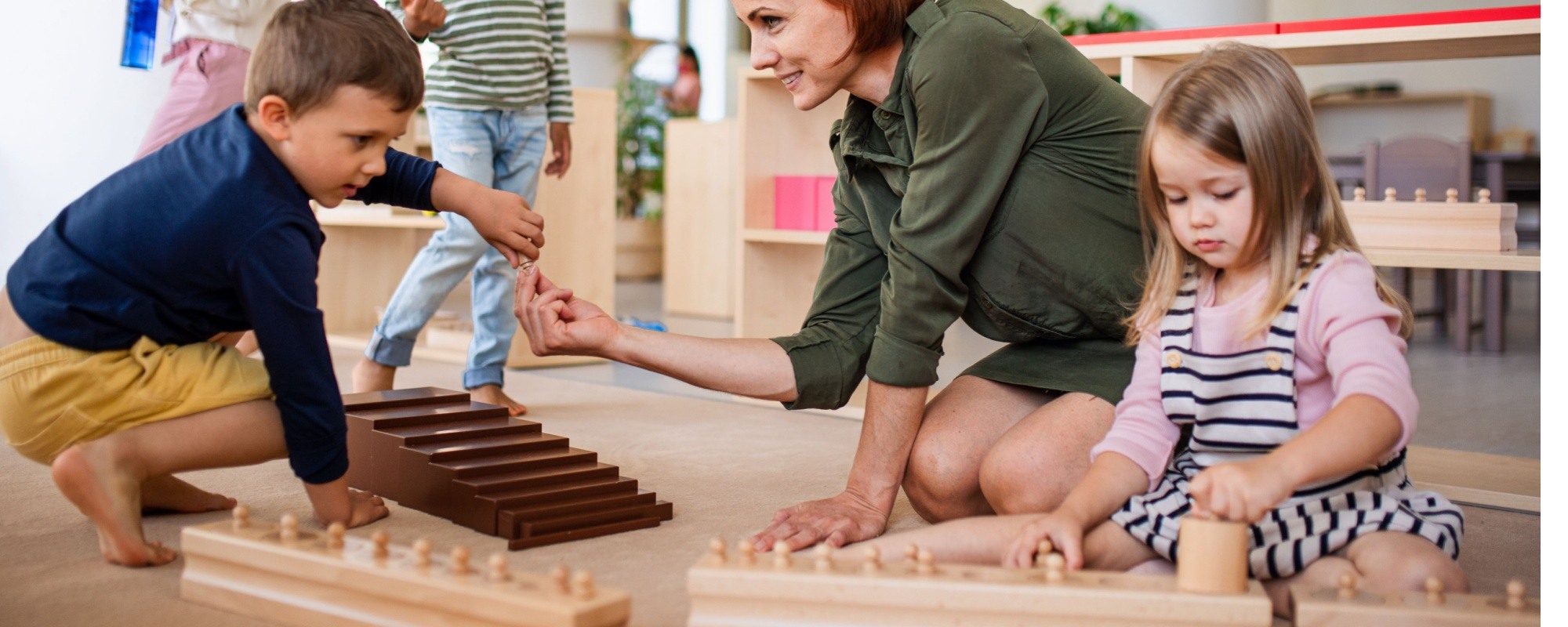
A Montessori preschool depends on a specifically designed environment to nurture early reading and math. The prepared learning environment supports children’s current needs and changes as they grow. Kids do self-care and daily living activities, becoming independent by caring for their environment. Furniture is selected for coziness and accessibility. Various subjects, such as practical life, art, reading, and math, are organized to expose children to and make materials accessible. Teachers monitor advancement by noting how kids pick and engage with objects. The prepared learning environment.
Montessori classrooms include a range of materials such as:
- Sandpaper letters for tracing and learning letter sounds
- Moveable alphabet sets for early writing and word-building
- Number rods and bead chains for counting and math practice.
- Handy-life implements such as brooms, pitchers, and washcloths are essential for day-to-day work.
- Counting trays, puzzles, and geometric solids to touch and manipulate.
- Storybooks and picture cards for language development
- Measuring cups and scales for real-world math understanding
These snuggly little reading nooks encourage them to develop a passion for books and quiet time. Shelves are low and open, so all resources are within reach, allowing children to make decisions independently. Allow materials to be ordered from easy to difficult, supporting incremental development.
Child-Led Discovery
Kids choose their own activities, and that enables them to gain confidence and responsibility in their learning. They explore subjects that ignite their interest, sometimes going the extra mile on what interests them most. With tangible materials, kids can feel, manipulate, and witness the mechanics of how things operate, turning abstract concepts into concrete understanding.
Teachers observe and support without leading every step, providing room for kids to discover solutions at their own rhythm. If a child flounders or loses interest, teachers tweak the environment or introduce new materials, always with an eye on the individual child.
Mixed-Age Classrooms
Members of different ages mingle in the same room, collaborating on projects and daily habits. Peer-to-peer learning is the norm, with older kids helping to instruct or demonstrate work to younger kids. This develops social skills and confidence at every age.
Kids learn patience, cooperation, and empathy as they collaborate. It fosters an intimate community in which every child feels valued and a part of.
Integrated Curriculum
We do not educate subjects separately but are interconnected by themes and real-life situations. For instance, a gardening unit integrates math with counting seeds and reading plant labels, and it integrates science with observing growth.
Kids apply cross-subject skills to a single project, so learning is relevant and integrated. This arrangement prompts out-of-the-box thinking and allows kids to generalize their knowledge in multiple directions.
How Montessori Teaches Reading
Montessori preschools offer a hands-on, child-centered approach to early reading instruction, emphasizing the Montessori method. Rather than begin with letter names, they introduce children to phonemes and sounds, helping lay a solid groundwork for literacy. Phonics is a core component, as kids learn to decode words by their sounds instead of memorizing them. Sound games, nursery rhymes, and tactile tools enable them to associate language with the written word. Reading materials and lessons are tailored to each child’s interests and early childhood level, which encourages engagement.
1. Phonological Awareness
Montessori classrooms build phonological awareness with playful activities that draw attention to the sounds that comprise words, essential for the literacy journey of young children. Kids engage in games that isolate syllables and rhymes, such as clapping to the syllables in names or matching rhyming objects. These activities not only develop auditory discrimination but also help children hear sounds individually, laying the groundwork for reading. Phonetic objects, tiny items representing different sounds, bring these abstract sounds to life, supporting the Montessori method of learning.
2. Tactile Letter Recognition
Sandpaper letters are a quintessential Montessori implement that enhances the Montessori method for teaching literacy. Each letter is cut from sandpaper and mounted on a board, allowing young children to trace its shape with their fingers while hearing the sound. This sensory learning is amplified with tactile materials and multi-sensory games, such as matching letters to objects or tracing letters in sand, supporting their literacy journey and aiding the consolidation of visual and tactile memory.
3. From Writing To Reading
Montessori has us focus on writing before reading, which is essential for early readers. Kids employ moveable alphabets—letters they can place onto a mat—to construct words before they encounter them in print. Journaling and creative writing are encouraged, even if kids resort to phonetic spelling. As children write, they learn letter-sound correspondence, supporting their literacy journey. Shared experiences, like collaborative storytelling, assist in connecting writing to reading.
4. The Moveable Alphabet
The movable alphabet in a Montessori environment provides children with a means to play with making words on their own. By manipulating letters physically, they investigate phonetic combinations and grow their vocabulary, enhancing their literacy journey. This enables children to experiment with spelling new words and early writing without the confinement of fine motor skills.
5. Reading Comprehension
Guided reading sessions in the early childhood classroom teach essential reading comprehension skills. Young children are excited to talk about stories, answer questions, and make predictions that deepen their literacy journey. Montessori teachers ask open-ended questions, encouraging early readers to articulate their thinking while using a diversity of reading materials.
How Montessori Teaches Math
Montessori preschools teach math with a hands-on approach that helps kids associate real objects and actions with abstract concepts. This Montessori math education focuses on using materials and practical life activities to develop a solid foundation, transitioning from concrete to abstract skills. Young children learn with beads, blocks, and sandpaper numbers, allowing them to see and feel what math means before ever learning symbols and written equations. This way, math seems more like life, not just a subject to be memorized.
|
Method |
Description |
Benefit |
|
Manipulatives |
Beads, blocks, sandpaper numbers, stamp games, fraction insets |
Make math visible, tactile, and relatable |
|
Real-world Scenarios |
Math in cooking, shopping, measuring, and cleaning |
Build practical problem-solving skills |
|
Visual Aids |
Bead chains, number cards, checkerboards |
Support understanding of complex ideas |
|
Positive Reinforcement |
Celebrate small milestones and successes |
Boost confidence and curiosity |
Concrete To Abstract
Kids begin their literacy journey with tangible things like golden beads and colored tiles to ground them in math. For instance, they use bead chains to count, skip count, and learn multiplication and division in a hands-on manner, while also incorporating Montessori math materials like sandpaper cards with numbers 0 to 9 for tracing digits. This makes the learning experience sensory and immediate.
Gradually, the lessons move away from these objects to more abstract work. Students use checkerboards to multiply and divide large sums, transitioning from hands-on to mental math. This helps kids create a bridge from what they can feel to what they can conceive.
Play and experimentation are essential in the Montessori environment. Kids could sort, stack, or group, discovering patterns and making discoveries on their own. Math pops up during snack time, cleanup, and outdoor play, cementing the lesson in ‘real life.’
Quantity Before Symbol
Children are exposed to and manipulate quantities — blocks, beads, or cards — before seeing what numbers on paper actually look like. They bunch, sort, and compare objects so that they understand what three or five means before they ever see the symbols 3 or 5.
This incremental route provides kids with the space to discover how numbers connect. Whether it’s sorting blocks, counting fruit, or matching socks, every demonstration proves that numbers arise from tangible items. Teachers highlight these connections in everyday life so kids can see math everywhere.
It’s not just memorization. Kids inquire and discover through experimentation and develop a deep intuition for the way numbers operate.
The Decimal System
Montessori teaches place value with golden beads and number cards. Children experience the distinction between units, tens, hundreds, and thousands of units. This work with hands demonstrates why each digit counts.
Visual aids, such as stamp games, facilitate learning of the four operations. Kids employ these tools to add, subtract, multiply, and divide, both solo and with peers.
As skills develop, children utilize materials such as fraction insets and checkerboards to investigate more advanced topics such as larger numbers, fractions, and even squaring and cubing. Games make larger ideas less intimidating and more enjoyable.
The Role Of Montessori Materials
Montessori preschools, with their purpose-built materials, create an environment where early readers can learn essential skills in reading and math through physical touch, movement, and repetition. The thoughtful design of these objects, ranging from glass unit beads to large wooden cubes, fosters both independent thinking and concrete understanding. Every single item in the classroom has been selected for its ability to support kids in developing their literacy journey incrementally, with an emphasis on real-life application.
Self-Correcting Tools
Self-correcting tools are the heart of the Montessori method. Her materials, such as the 100 board and control charts, are arranged in a way that allows kids to identify and self-correct errors without adult assistance. For math, number rods or spindle boxes enable a child to associate quantities with numerals, exposing mistakes if pieces are surplus or lacking. This builds confidence as kids know immediately where an error was made and can retry. By working with these Montessori math materials, kids begin to reason and engage in self-reflection about their decisions rather than simply waiting to be told where they’re wrong. This process instills in them a sense of mastery and independence, traits essential for lifelong learning.
Purposeful Design
Each Montessori material is crafted with a specific purpose, particularly in the context of early childhood education. For example, Golden Beads lay the foundation for the decimal system, helping early readers visualize and feel the distinction between units, tens, hundreds, and thousands. Natural materials like wood, glass, and metal ground kids in the world, making learning less abstract. The environment of a Montessori classroom, tidy and colorful, stirs interest and maintains kids’ attention. Activities are structured to allow young children to repeat them, mastering each step on their own schedule while still challenging them to explore ideas independently.
Hands-On Engagement
Tactile learning lies at the heart of the Montessori method. Children manipulate and move objects such as ten bars, hundred squares, and spindle boxes to learn counting, place value, and even the concept of zero. It’s not all about math; the Montessori language materials, including sandpaper letters, bolster early literacy skills by allowing children to trace, match, and sort sounds and words. Working side by side or in small groups, they build teamwork, share ideas, and learn from one another. This practical approach connects theoretical concepts to direct experience, cementing the learning journey.
Beyond Academics: The Whole Child
Montessori education considers early reading and math as just a piece of the child’s literacy journey. Social-emotional development, self-expression, and pragmatic skills all play a huge part in early childhood education. Our classrooms combine academic material such as language, math, and science with activities that foster confidence, empathy, and independence. Teachers remain with their class for multiple years, providing kids a feeling of security and consistency, which cultivates critical thinking and collaboration, essential skills for the modern world.
Practical Life Skills
- Pouring water
- Measuring ingredients
- Setting the table
- Baking bread
- Sorting objects
- Sweeping and cleaning
- Buttoning and zipping clothes
The kids do daily chores, like laying the lunch table or baking the bread, which not only instruct them how to tally, gauge, and categorize but also develop essential skills in early childhood education. These activities provide fine motor practice, like pouring and buttoning, while fostering independence. Over time, as they assume control of their own assignments, they learn accountability and autonomy, crucial for their literacy journey.
Sensorial Exploration
Montessori schools provide a lot of sensory opportunities for children. Classroom materials could be textured fabrics, sound cylinders, or scent jars. Through these activities, children begin to observe subtle distinctions, like soft versus rough or loud versus quiet. As children manipulate these items, they refine their observational and classification skills.
Brief lessons immerse kids into the basics of biology, geometry, and geography. For instance, kids could group leaves by form or pair puzzle maps, setting the stage for sophisticated learning down the road. This experiential learning promotes wonder and enables kids to better understand their environment.
Fostering Independence
Montessori teachers encourage children to select their own work and make small decisions, like which book or math work to attempt. Kids figure out problems as they arise, with teachers intervening only when necessary. By taking charge of their own education, kids become more confident.
Milestones—like writing a first word or helping a friend—are celebrated, regardless of size. This develops their self-confidence and makes every child feel appreciated.
Assessing Progress Without Tests
Montessori preschools have a different approach to measuring your child’s progress in reading and math. Instead of tests or grades, teachers observe and collaborate with each student to obtain a comprehensive understanding of their knowledge and abilities. This method respects each child’s pace, skills, and interests, viewing learning as a literacy journey rather than a sprint. It’s not about scores; it’s about what the kid knows and how he applies new concepts in his regular assignments.
|
Assessment Method |
Characteristics |
|
Observation |
The teacher notes how the child solves problems, interacts, and explores materials. |
|
One-on-One Conferences |
The teacher and child talk about what the child is learning, what is hard, and what the child wants to try next. |
|
Descriptive Feedback |
The teacher gives feedback that shows what the child did well and what could be tried next, using clear, supportive words. |
|
Self-Reflection |
A child thinks about their own work, sets small goals, and sees their own growth. |
|
Connection to Environment |
The child shows skills by working with real materials, using pattern blocks, number rods, and letter tiles. |
Montessori teachers provide feedback in daily conversations rather than grades or stickers, reinforcing the idea that learning is an individual process. This assists the child in viewing learning as something they undertake for themselves, not for reward. For example, when a child matches number rods by size or groups beads by color, the teacher may say, ‘You lined up the rods from shortest to longest,’ as opposed to ‘Good job.’ This approach emphasizes what the child accomplished, bolstering confidence and a sense of actual progress while keeping their passion for learning alive. Grades and tests tend to dampen curiosity, particularly among early readers.
Goal setting and self-reflection are built into every day. Kids choose what they want to continue working on, review their performance, and reflect on what they want to attempt next. This builds self-knowledge and a clear sense of personal growth. Montessori teachers inspire kids to be adventurous, work through errors, and view exertion as positive. This focus on growth, rather than scores, allows kids to persist even when they encounter challenges in their early childhood education.
Conclusion
Montessori preschools teach early reading and math with hands-on tools and a classroom that encourages them to work independently and with peers. Children match letters to sounds with sandpaper letters and read simple words early on. For math, they sort beads, count objects, and identify genuine patterns. Teachers step back, observe, and intervene with assistance just at the appropriate moment. Kids learn at their own pace and develop genuine skills, not just rote memorization. The emphasis remains on the holistic child — how they think, collaborate, and solve problems. Many families have their children develop firm roots in reading and math. If you want to know more, visit a local Montessori school and discuss with the teachers their method.
Frequently Asked Questions
1. What Is A Montessori Prepared Learning Environment?
A Montessori prepared environment is a thoughtfully organized space that enhances early childhood education. It promotes autonomy, selection, and experiential learning through accessible materials that encourage self-directed exploration.
2. How Do Montessori Schools Teach Early Reading Skills?
Montessori schools use phonics instruction and hands-on materials, such as letter sandpaper letters, to teach young children reading. This Montessori method helps them identify words and gain reading confidence in a natural, self-motivated manner.
3. How Is Math Introduced In Montessori Preschools?
Math is presented with hands-on objects such as beads and number rods, which are part of the Montessori math curriculum. This hands-on methodology helps young children grasp abstract ideas, making counting, adding, and subtracting more accessible.
4. What Role Do Montessori Materials Play In Learning?
Montessori materials are self-correcting and engaging, supporting early childhood education by allowing young children to learn through hands-on activities. This approach nurtures their literacy journey, developing confidence and comprehension.
5. How Is Progress Assessed In Montessori Preschools?
In a Montessori environment, teachers monitor children’s work daily, observing their progress in literacy through records and portfolios instead of conventional tests.
6. Does Montessori Education Focus Only On Academics?
Montessori education nurtures the whole child by fostering social, emotional, physical, and cognitive development, essential skills for their literacy journey and cooperation.
7. Are Montessori Methods Suitable For Children From Diverse Backgrounds?
The Montessori method is flexible and inclusive, honoring each child's individual literacy journey and cultural context, explaining its effectiveness for young children everywhere.
Support Your Child’s Growth Through Montessori Philosophy And Early Learning
Curious how Montessori philosophy and early learning can shape your child’s development? We invite you to experience it firsthand at Fountainhead Montessori in Livermore. Our classrooms are carefully prepared to support curiosity, independence, and a genuine love of learning, giving young children the freedom to grow at their own pace in a calm, supportive environment. Optional before- and after-care is also available for families who need flexible schedules.
Click below to schedule a personal tour, download our free parent guide, or review our transparent tuition rates. If you’re wondering whether Montessori philosophy and early learning are the right path for your child, our admissions team would be happy to answer your questions and help you find the best fit for your family.






Let us know what you think about this post
Put your Comment Below: