

In a Montessori daycare, early learning can happen while a child pours water, sorts objects, listens to a story, or returns a material to its shelf. Each activity gives the child something to practice, and a teacher observes when to demonstrate a new step or offer help. For Danville families considering this approach, the question is how those everyday activities support language, coordination, concentration, and independence.
The prepared classroom, hands-on materials, and opportunities to work with other children are central to the method. Their value depends on how teachers use them and respond to each child. Here is what those practices can look like and what to ask when visiting a program.
Key Takeaways
- Montessori programs combine self-paced, hands-on activities with teacher demonstrations, individual guidance, and group experiences.
- Primary Montessori classrooms commonly group children ages three to six. Younger children can learn by observing older classmates, while older children gain practice explaining and demonstrating skills.
- Research has found benefits in some academic and developmental outcomes, but findings vary and do not guarantee results for an individual child or school.
- A calm room alone does not establish program quality. During a tour, watch whether children are engaged and whether teachers respond warmly when a child needs help or a conflict arises.
- Compare teacher preparation, classroom practices, supervision, and responses to children’s needs alongside the school’s educational approach.
What Is Montessori Education?
Core Philosophy And Method
Dr. Maria Montessori, an Italian physician and educator, developed her approach through observation of children’s learning and development. Her work in Rome in the early 1900s helped establish a method built around purposeful activity, a prepared environment, and freedom within limits. Children’s interests inform their choices, while teachers use a sequenced curriculum and observation to introduce suitable challenges.
Prepared Environment Design
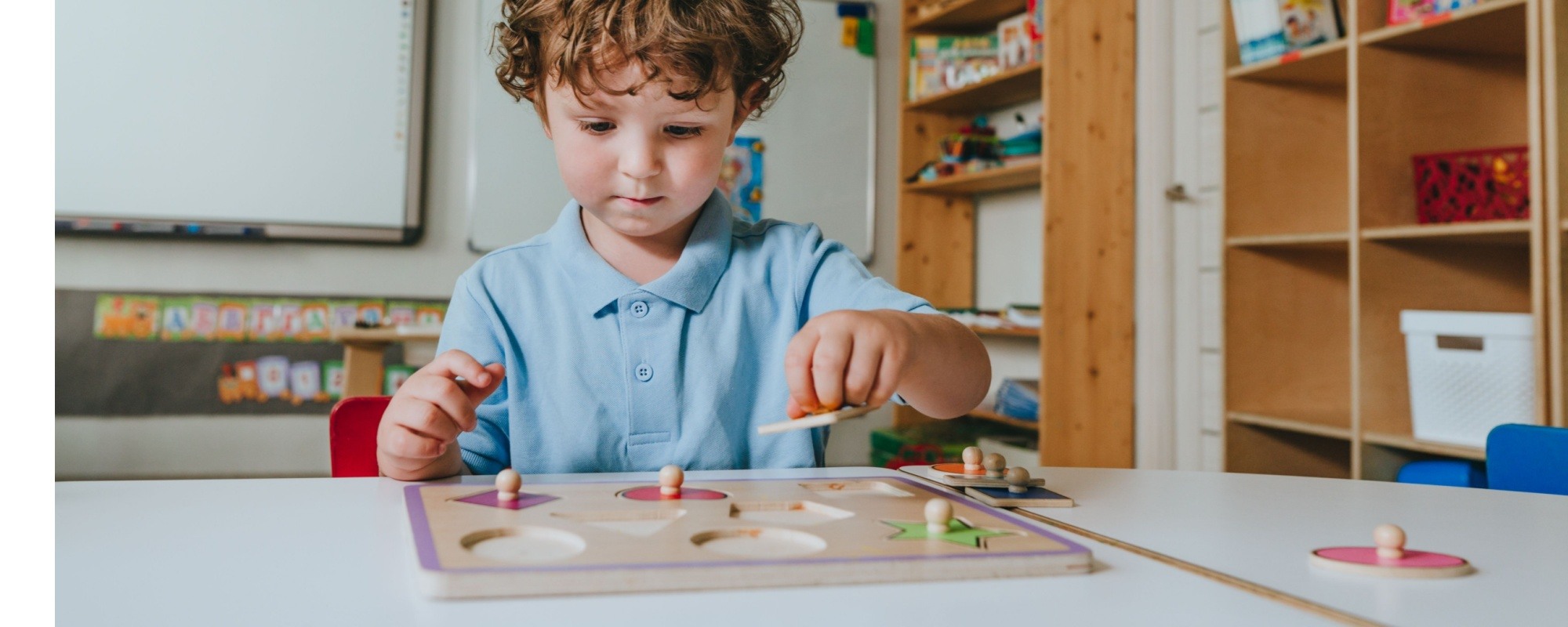
A Montessori prepared environment places suitable materials where children can access them and provides space to use and return them. Child-sized furniture and organized activity areas support participation, with the layout adapted to the ages and needs of the group. A toddler might choose an introduced activity, carry it to a table, and put it away with help. Over time, familiar routines provide opportunities to do more independently.
Choice in a Montessori room takes place within clear boundaries. Children choose from activities that have been prepared for their age and that a teacher has shown them how to use. They are also expected to handle materials with care, respect another child’s work, and return an activity when finished. Those expectations give a young child a manageable way to practice decision-making. The teacher remains responsible for safety and steps in when a child needs support.
Many Montessori materials also let a child notice an error while working. Pieces may fit only in a particular place, or a sorting activity may leave an object that does not belong with the others. The child can look again and try a different approach before asking an adult for the answer. This does not mean every mistake must be worked out alone. A teacher may repeat the demonstration, simplify the task, or put it aside until the child is ready to return to it.
The room’s layout helps these small learning moments happen throughout the day. Space to carry a tray, a place to complete an activity, and an accessible shelf for returning it all support the same routine. Completing that routine requires a child to remember several steps, coordinate movement, and consider other people using the room. Independence grows through those repeated opportunities, with help available when needed.
Teacher Guidance And Individual Lessons
In a Montessori classroom, the teacher observes children, demonstrates activities, and offers support when needed. Lessons may be given to one child or a small group. The teacher also helps children use materials safely, navigate conflicts, and take part in the classroom routine. This guidance makes independent work possible.
How Does Montessori Support Early Learning In Danville?
Self-Paced Skill Development
In a Montessori classroom, a child can return to pouring, buttoning, counting, or letter work as their skills develop. The teacher observes the child’s progress and introduces the next activity when the child is ready. This gives parents a concrete question to ask on a Danville tour: how does the school decide when to introduce new materials, and how does it share progress with families?
Sensory-Based Cognitive Growth
Montessori materials invite hands-on exploration through activities such as tracing sandpaper letters, counting beads, or holding and rotating geometric solids. These materials let children explore ideas through touch, movement, and repetition before working with more abstract symbols. A teacher can observe how a child uses a material and offer another demonstration or a new challenge when appropriate.
Executive Function And Independence
A 2025 national study of public Montessori preschools found stronger average executive function outcomes by the end of kindergarten among children offered places through school lotteries. The finding supports the value of studying the approach, but it does not predict an individual child’s outcome at a particular Danville daycare. Choosing work, following through, and managing transitions give children opportunities to practice attention and self-regulation.
Which Age Groups Do Danville Montessori Daycares Serve?
Enrollment ages vary by campus. Montessori programs may serve infants, toddlers, or preschoolers, but a school does not necessarily offer all three. Fountainhead Montessori School of Danville lists Toddler/Prep and Primary programs. Confirm placement and current availability directly with the campus. The age ranges below describe common Montessori groupings rather than a guaranteed enrollment range at every school.
|
Age Group |
Typical Focus |
Questions For The School |
|
Toddler (18 Months To 3 Years) |
Language development, practical life skills, growing independence |
Ask how the school supports language, movement, naps, and toileting. |
|
Primary (3 To 6 Years) |
Pre-literacy, early math, social problem-solving |
Ask which ages share the classroom and how new lessons are introduced. |
Toddler Programs
Toddler classrooms commonly emphasize language, movement, practical life activities, and growing independence. Ask each Danville school which ages it enrolls and how it handles naps, meals, toileting, and transitions. Infant care should be discussed only if the specific campus offers it.
A toddler’s work may look quite different from the work in a primary classroom. A younger child might carry a small object across the room, name pictures with an adult, wipe a table, or practice putting on a coat. Each activity gives the child a chance to use language and movement for a purpose. A teacher can adjust the task to the child’s current abilities: a pitcher may hold only a little water, for example, so a spill is manageable and the child can try again.
Toddlers also learn through routines they can anticipate. Washing hands before a meal, finding a place for belongings, and helping put materials away are opportunities to hear words, follow a sequence, and take part in group life. A child who is still learning to speak may first watch a demonstration or communicate through gestures. The teacher’s role is to notice what the child understands and offer enough help to keep the experience positive.
As children grow, the range of materials and the length of time they can work with them may change. A primary-age child may move from naming objects to matching sounds with letters, or from sorting quantities to using materials that represent numbers. These are examples of a possible learning sequence, not a timetable every child must follow. Families comparing toddler and primary programs should expect the classroom activities and adult support to reflect those different developmental stages.
Primary Classrooms Ages Three To Six
The Primary classroom, sometimes called the Children’s House or Casa, commonly serves children around ages three to six, although some programs enroll younger children. Its curriculum includes practical life, sensorial work, language, math, and cultural subjects. Teachers introduce concrete materials and activities that help children explore ideas before moving toward abstraction.
Mixed-Age Mentorship Benefits
In a mixed-age primary classroom, younger children can observe activities that older classmates already know, while older children may have chances to explain or demonstrate familiar work. Teachers still decide which materials to introduce and help children respect one another’s concentration. How much peer interaction occurs will vary by classroom and child.
Learning from peers is not limited to an older child showing a younger one how to use a material. Children also see how classmates wait while an activity is in use, make room for someone carrying work, and ask to join a conversation. These ordinary encounters give teachers opportunities to model respectful words and help children practice using them. A mixed-age group still needs active adult guidance; placing children of different ages together does not automatically teach cooperation.
For a younger child, watching an older classmate can make an unfamiliar activity easier to understand. The younger child can see where to begin, how long the work takes, and what happens when it is finished. Older children have opportunities to explain a familiar task, but they should not be expected to act as substitute teachers. The classroom guide remains responsible for judging whether an activity is suitable and for helping each child participate.
This arrangement also means children need space to work alone. An older child may be concentrating on a complex task and may not want an observer to touch it. Learning to ask, wait, or choose another activity is part of respecting another person’s work. Parents can look for a balance: children should be able to learn alongside peers while also having their own efforts protected from interruption.
How Does Montessori Compare To Traditional Preschool?
Instruction Style Differences
Preschool programs vary in how they combine group activities, play, and individual work. Montessori programs generally place more emphasis on children choosing from prepared activities during a sustained work period, with teachers giving demonstrations and observing progress. Families can ask each school how much of the day is spent in group activities and how children receive individual guidance.
Classroom Structure And Materials
Classroom materials and routines vary among preschool programs. Montessori classrooms generally organize materials so children can return to an activity and practice it over time, while teachers introduce new work as children are ready. Ask each school how it balances familiar activities with new experiences.
Academic And Social Outcomes
A 2006 study in Science by Angeline Lillard and Nicole Else-Quest found advantages on selected academic, executive function, and social measures among five-year-olds at one public Montessori school. The study does not establish how every Montessori preschool will perform. Chloë Marshall’s 2017 review in npj Science of Learning described promising findings while highlighting methodological limitations and differences in implementation.
What Are The Benefits And Drawbacks Of Montessori?
What Research Can And Cannot Show
Research findings describe average results for the children and schools studied. They do not establish that every developmental area improves or that a particular child will benefit in the same way. Families should connect broad research findings with practical questions: how does this classroom support concentration, introduce new skills, and help children build relationships?
Common Criticisms Worth Considering
Potential concerns are best assessed in the actual classroom. Ask how children can pursue art, imaginative play, and spontaneous interests alongside the intended use of Montessori materials. Find out how teachers support a child who needs more direction or avoids choosing work. Montessori training, program hours, tuition, and available support can also vary, so the educational label alone cannot settle whether a program fits your family.
What Local Parent Reviews Reveal
When reading parent reviews, look for specific descriptions of teacher communication, children’s engagement, and how staff responds when a child needs help. A review cannot show you how the classroom operates every day, so use those comments to form questions for your tour.
How Should Danville Parents Choose The Right Preschool?
Questions To Ask During A Tour
Ask whether new activities are demonstrated one-on-one or to a small group. Ask how long children typically work on one activity before switching. Ask how staff handle a toddler biting or grabbing, since the answer reveals a lot about the emotional climate of the room.
How Learning Progress Is Shared With Parents
Ask the teacher to show how they record observations and decide which material to introduce next. A useful answer should describe what a child is practicing now, what the teacher has noticed, and how the school communicates that progress to families. Counting a completed worksheet is rarely the best way to understand work with Montessori materials. Parents should be able to hear specific examples of growing coordination, language, concentration, and social skills.
Ask what happens when a child repeatedly avoids an activity or returns to the same one for weeks. The teacher should be able to explain when repetition supports mastery and when a child may need a new demonstration, a different material, or more help. This is especially useful if you are comparing programs for a child who is new to group care.
How The School Supports A New Child
A child may need time to learn where materials belong, how to ask for a turn, and what to do after finishing an activity. Ask how teachers introduce these routines during the first weeks. Also ask how they respond if a child watches others instead of choosing work, misses a parent at drop-off, or becomes frustrated by a task. These answers show how the school combines independence with adult support.
Daily care matters alongside the learning method. Ask about outdoor time, meals, naps, toileting, and communication after an injury or difficult day. For toddlers, find out how teachers adapt the routine when a child needs rest or individual attention. A classroom approach is useful to a family only when the full day meets the child’s needs.
What To Compare After The Tour
Write down the age range, available schedule, tuition, enrollment availability, and the teacher’s answers while they are fresh. Then compare what you observed: Were materials accessible? Did children have time to finish? Did an adult notice a child who needed help? Were expectations explained clearly to you? These details make a more reliable comparison than a school’s use of the Montessori name. If possible, ask to observe during a normal work period so you can see how the classroom functions beyond a brief introduction.
Signs Of An Authentic Montessori Program
Ask about age-specific Montessori teacher credentials, the sequence of classroom materials, mixed-age grouping, and protected time for child-chosen work. Work periods should suit the children’s ages and program length, and their duration is only one aspect of Montessori practice. Verify any claimed school accreditation or recognition separately from teacher credentials and organizational membership.
Red Flags To Watch For
Follow up if a school cannot explain its teachers’ Montessori preparation, how materials are introduced, or how children receive individual guidance. Ask for clarification if the advertised approach differs from what you observe. Group lessons and predictable schedules can be part of Montessori; the question is how they fit alongside meaningful choice, sustained activity, and responsive care.
What Should You Look For During A Danville Daycare Tour?
Observe transitions as well as activities. When a child finishes, notice whether they know where materials belong and whether an educator helps when needed. If someone becomes frustrated, look for a calm response suited to the situation. Immediate assistance may be appropriate, while another child may benefit from time to try again. Ask staff to explain their decisions instead of treating quiet behavior or purposeful movement as proof of quality.
How Do Montessori Materials Teach Math And Language?
The sequence matters as much as the material itself. A teacher first demonstrates an activity, then gives the child time to try it independently and return to it on another day. A child sorting objects by size, for example, practices careful observation and order before those ideas appear in more formal math work. When a task becomes familiar, the teacher can introduce a related challenge. Ask during a tour how staff decide when to repeat a lesson, offer help, or move to the next material.
Early language learning also extends beyond sandpaper letters. Conversations, naming objects, listening to stories, and explaining a choice all give children opportunities to use new words. Practical life work adds another layer: carrying a tray, fastening clothing, or cleaning a small spill requires planning and coordination. These ordinary activities help explain what early learning looks like during a Montessori day, even when a child is not doing work that resembles a conventional academic lesson.
In early math, children usually begin with quantities they can see or handle. They may match a number symbol to a set of objects, arrange materials from shortest to longest, or count beads one at a time. Later, materials can represent groups of ten, one hundred, and one thousand. Handling those quantities helps a child see why the symbols differ before being asked to calculate using symbols alone. Teachers introduce each activity in a sequence, so a child’s experience depends on what they have already practiced.
Language follows a progression too. A young child hears and uses words in conversation before connecting spoken sounds to written letters. In a primary classroom, a teacher may invite children to listen for a sound at the beginning of a word, trace the corresponding sandpaper letter, and eventually use a movable alphabet to form words. Recognition, writing, and reading do not develop at an identical pace for every child. The teacher can observe which connection the child is working on and provide practice without turning each attempt into a test.
Montessori classrooms may also introduce subjects such as plants, animals, geography, and art through objects, pictures, conversation, and direct observation. A child looking closely at a leaf, for example, can describe its shape, compare it with another leaf, and learn new vocabulary. That experience draws on attention and language as well as knowledge about nature. The value lies in what the child notices and can discuss, not in memorizing a label after one lesson.
These learning areas often meet in a single activity. Preparing a snack can involve counting pieces, naming foods, coordinating small movements, and taking care of a shared space. Teachers can use those moments to observe what a child can do independently and where a demonstration would help. For parents, this explains why early learning in a Montessori daycare may be visible in everyday work as well as in recognizable reading or math materials.
Conclusion
Montessori programs support early learning through guided choice, repeated practice, hands-on materials, and interaction with adults and peers. The classroom’s value depends on how educators use those practices and respond to individual children. Research provides context, while observations and direct conversations help families assess a particular program.
To learn about Fountainhead Montessori School of Danville, call (925) 820-6250 to ask about current programs, educator preparation, schedules, tuition, and a personal tour. Discuss your child’s needs and ask how teachers introduce activities and share learning progress with families.

Frequently Asked Questions
1. Is Montessori Good For Anxious Or Shy Children?
A child who is shy or needs time to feel comfortable may appreciate opportunities to observe and join activities gradually. Montessori is not automatically the best fit for every child. Ask how teachers provide reassurance, support group participation, and communicate with families when a child remains distressed or withdrawn.
2. How Much Does Montessori Daycare Cost In Danville?
Tuition depends on the campus, your child’s age, and the schedule you choose. Ask the school for its current rates and a breakdown of any enrollment, materials, or extended-care charges before comparing programs.
3. Can Children Switch From Traditional Preschool To Montessori Mid-Year?
A child may be able to join mid-year if the school has space and accepts enrollment at that time. Ask how teachers introduce new children to classroom routines and how they support a child adjusting to a different approach.
4. Do Montessori Students Perform Well In Traditional Elementary Schools?
Children’s experiences after Montessori preschool vary. Research has found positive outcomes for some groups, but it cannot predict how an individual child will adjust to a particular elementary school. Ask the preschool how it prepares children for a new classroom routine and communicates their progress to families.
5. How Many Hours A Day Should A Toddler Attend Montessori?
Available schedules vary by school. Ask which half-day and full-day options the Danville campus currently offers, how naps and meals fit into each schedule, and which option suits your child’s age and routine.
Explore Montessori Daycare In Danville
Choosing a daycare is a personal decision. Reading about the Montessori approach can help you understand its principles, but a classroom visit gives you a closer look at the daily routine, the materials children use, and the way educators guide their activities. It also gives you time to ask how the program supports children at your child’s age and how families receive updates.
If you are considering Montessori daycare in Danville, contact our team to discuss your child’s needs, ask about current availability and enrollment, and arrange a tour. We can answer your questions so you can decide whether the program is a good fit for your family.
Disclaimer:
This article provides general information about Montessori daycare in Danville, CA. Programs may differ in their teaching practices, age groups, schedules, fees, and availability. Before enrolling, contact the provider directly, visit the classroom, and check its current licensing information with the California Department of Social Services. The information here does not replace an individual assessment of whether a program meets your child’s needs.






Let us know what you think about this post
Put your Comment Below: