

A Montessori preschool method for supporting toddlers means leveraging hands-on, child-led approaches to assist little ones in developing. Montessori preschools allow toddlers to choose their own activities from a selection of secure, age-appropriate options. Teachers retreat and observe, interfering only to direct or assist. In these classrooms, you find quiet, airy rooms with real-world objects such as mugs, basic puzzles, and books within easy reach. Children proceed at their own pace, developing abilities in motor, language, and cognitive development. Group time is brief so that every toddler has room to work independently or with peers. Many parents even get involved, collaborating with instructors to align home and school practices. The following slices provide more of what works best for toddlers.
Key Takeaways
- The Montessori preschool method creates a carefully prepared environment that encourages toddlers to explore independently while ensuring safety and accessibility.
- Child-led discovery, where toddlers select activities that correspond to their interests and developmental level, fuels curiosity and self-motivation.
- These are incorporated into practical life skills through daily routines, which help toddlers develop competence, confidence, and social skills by participating in hands-on tasks.
- Sensory exploration is highlighted, with each activity designed to support cognitive, language, and physical development, engaging all the senses.
- Teachers serve as observers and facilitators, tailoring assistance and working with parents to cultivate the individual development of each child in an organized but adaptable environment.
- Montessori isn’t just about academics. It fosters emotional intelligence, social grace, and physical confidence. All of these contribute to well-rounded development for toddlers.
The Montessori Toddler Method
Montessori toddlers benefit from a kid-centric approach that emphasizes respect, autonomy, and hands-on learning. The Montessori toddler program, developed by Maria Montessori, focuses on hands-on discovery and flexible rhythms for 2 to 3-year-olds, fostering agency, independence, and gradual maturation.
1. The Prepared Environment
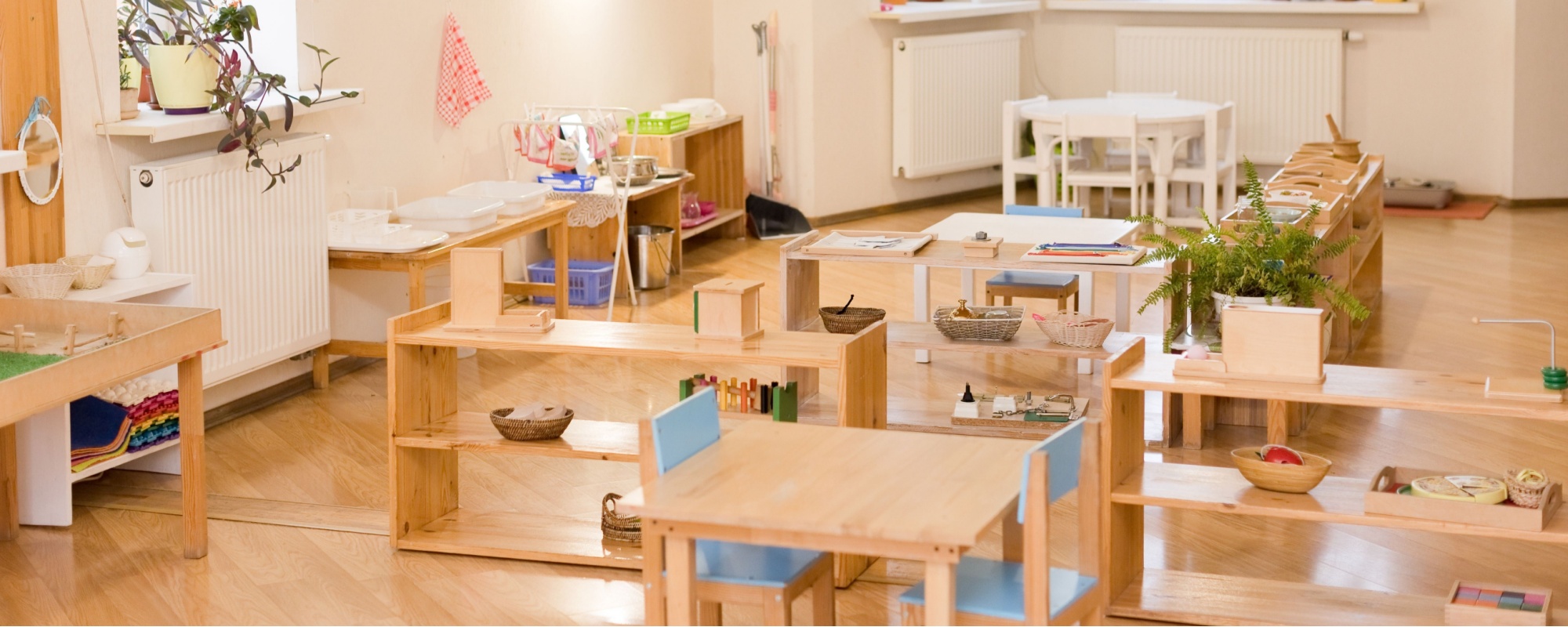
Something we often overlook is planning a Montessori toddler program space for toddlers. Furniture is scaled down, and shelves are kept low so kids can easily grab whatever they need. Toys and learning materials are organized by category in baskets or trays, not strewn about or put away. In a Montessori classroom, kids roam, selecting what to work on and cleaning up when complete. Materials are frequently crafted from wood, cotton, or metal. These natural textures tempt contact and instill a serene ambiance, ensuring a safe, clean, and open environment for toddlers to explore with security.
2. Child-Led Discovery
In a Montessori classroom, kids actually get to choose their own activities, creating a powerful sense of ownership. Materials span from puzzles to art supplies, and teachers or caregivers observe, assist when necessary, and allow children to advance at their own speed. Open-ended activities, such as stacking blocks or shape sorting, allow toddlers to experiment and overcome mini-challenges independently or collaboratively, fostering essential skills that support their social development.
3. Practical Life Skills
Easy chores—pouring water, sweeping, buttoning a shirt—are integrated into each day in a Montessori toddler program. These practical life activities build hand muscles and instruct careful movement, fostering essential skills. Children assume responsibilities such as preparing the table or watering flowers, which enhances their emotional growth and social development.
4. Sensory Exploration
In a Montessori toddler program, toddlers investigate with every sense, engaging in activities like dealing with sand and listening to music. This hands-on work not only promotes brain development but also fosters essential life skills, allowing children to understand their universe. As kids describe their experiences, their vocabulary expands, enhancing early language and social skills crucial for their growth.
5. Freedom With Limits
In a Montessori toddler program, toddlers have options within defined, secure limits. They may choose between two snacks or which book to read next, fostering independence. Clear and consistent boundaries teach toddlers self-discipline and accountability, while the Montessori approach of freedom combined with structure makes kids feel safe and autonomous, satisfying their need to explore.
How Educators Guide Toddlers
Educators in Montessori preschools foster toddler development through the Montessori approach by observing, supporting, and collaborating with families and children. They strive to create a nurturing classroom environment where every kid’s needs are fulfilled, confidence is developed, and Montessori education occurs organically.
The Observer
Montessori teachers take time to observe each toddler and discover what interests them and what skills they are developing. They observe behaviors such as how a child approaches play, tackles challenges, or participates in group activities. This assists them in identifying when a child is primed for a new challenge.
From these observations, teachers modify what they provide to the classroom. If a toddler is interested in pouring water, a teacher might arrange a practical life activity, such as pouring from a jug to a cup. They track development as well, so they can provide families with rich feedback and identify next steps. Teachers meet frequently to discuss what they observe and learn from each other, ensuring that their observational expertise continues to develop.
The Guide
Educators are more like guides than teachers. They allow toddlers to pick activities, intervening merely to offer soft assistance to a challenge. For instance, a teacher might say, “Would you like to put away the blocks or draw a picture now?” rather than instructing the child on what to do next. This decision empowers toddlers to feel in control and begin making decisions.
Guides employ scaffolding by providing just enough assistance for the child to accomplish something, like demonstrating how to zip a jacket or use a spoon,n and then immediately retreating. The 3-period lesson is one way guides introduce new ideas: first naming an object, then asking the child to find it, and finally having the child name it on their own. Respect informs every moment. Educators respect each child’s rhythm and support their exploration.
The Partner
Teachers collaborate with families, exchanging advice and updates so parents can support learning at home. They welcome parents into the room for easy projects, from communal snacks to book readings, reinforcing the home-school connection.
Social skills are constructed by intermingling children of varying ages. Big kids can demonstrate to little kids, and little kids watch and learn. This collaboration fosters a feeling of community and allows toddlers to continue practicing collaboration.
Beyond Academics
Montessori preschool goes way further than academics, as the Montessori approach nurtures a child’s development in multiple areas, providing toddlers with a well-rounded base for life. In the majority of Montessori classrooms, your child’s teacher focuses on the whole child, not just numbers or letters.
- Emotional development
- Social skills and communication
- Physical movement and body control
- Problem-solving and reasoning
- Empathy and self-awareness
- Grace and manners
Emotional Intelligence
Montessori guides assist toddlers in naming and discussing their emotions. It helps children develop emotional resilience, which is crucial for coping with stress and adapting to change. When toddlers role-play or listen to stories, they begin to understand how others feel as well.
Teachers arrange opportunities for children to collaborate. They learn to share, work out small conflicts, and make friends. In our multilevel classrooms, the older children are always assisting the younger kids, displaying innate leadership. That back and forth develops empathy and teaches all kids to look through someone else’s eyes. Montessori students, it turns out, displayed more advanced social comprehension than many of their peers.
Mindfulness is incorporated into your daily routine. Toddlers pick up easy breathing or focus games to soothe themselves. Over time, these habits assist with self-control, a skill connected to superior health, money habits, and even adult decisions.
Social Grace
Adults in Montessori classrooms model respect through the way they speak and behave. Children emulate these behaviors and learn manners just by observing.
Team games and shared projects allow kids to work alongside one another. This arrangement assists toddlers in developing collaboration and knowing when to lead or follow. Kids practice sharing and waiting their turn, which fosters patience and trust. Montessori kids demonstrate strong conflict resolution and fairness, doing more high-level reasoning in tough moments, per studies.
Kindness and helpfulness get noticed and commended. They combine to help kids witness the impact of kindness firsthand.
Physical Confidence
Montessori classrooms are bursting with activities to feel, transport, spill, and shift. Basic actions such as walking a line or block construction enhance gross motor skills and body awareness.
Kids have a chance to practice new moves on their own terms. Safe spaces allow them to push without terror, constructing genuine self-assurance. Activities are designed so that children are exposed to balance and spatial awareness as well as body movement. This increases the chances of kids maturing comfortably in their own skin and being prepared for greater demands down the road.
The Myth Of Unstructured Chaos
A lot of people think that the Montessori toddler program is a free-for-all. This perception is off. Montessori classrooms are deliberately arranged, with every zone designed for the little ones to explore freely, but always within defined boundaries. It’s the teacher who imposes these boundaries and enforces them on children. They have a daily rhythm that helps kids understand what goes on and when. This structured environment sends young kids a feeling of security and allows them to focus on learning.
Freedom in Montessori is not chaos. Kids can choose what they work on, but they have guidelines to abide by. For instance, a child might go for a puzzle, but they have to finish it and put it away before picking up another. The teacher, known as a guide, intervenes when necessary. They teach kids how to work through challenges, assist with obstacles, and provide gentle nudges. This balance of freedom and structure allows children to explore at their own speed, yet always in a logical manner, which is a key aspect of the Montessori approach.
Self-directed learning is central to Montessori education. Kids build confidence when they pick their own work. They learn to solve problems, think independently, and persist through difficulty. Research indicates that Montessori children are more independent thinkers and more innovative. For toddlers, this translates into learning to share, converse, and deal with emotions in a secure, structured environment.
Conclusion
For toddlers, Montessori preschool provides a quiet haven in which to flourish at their own speed. Children walk, play, and choose activities with real materials. Teachers step back to let curiosity lead. Every day, small actions construct competencies for life, not just for school. It bypasses misguided regulations and teaches children with real materials, not through rote drill. Families experience children who begin to assist, communicate, and reason independently. Other children flourish in this calm, open environment. Some might require more or less structure. To choose the right fit, visit or chat with teachers. Listen to your instincts and choose what resonates with you as a parent and your lifestyle. Take baby steps and determine what works for you.
Frequently Asked Questions
1. What Is The Montessori Preschool Method For Toddlers?
The Montessori toddler program exemplifies child-centered education, supporting toddlers in learning through hands-on experience and discovery. This nurturing classroom environment is purposefully designed to foster independence and confidence.
2. How Do Montessori Educators Support Toddlers?
In a Montessori toddler program, teachers lead rather than teach, observing each child's needs and interests, and then providing materials and subtle assistance to help toddlers learn at their own pace.
3. What Skills Do Toddlers Develop In Montessori Classrooms?
In a Montessori toddler program, toddlers gain practical life skills, language, social skills, and problem-solving skills, fostering independence, respect, and curiosity.
4. How Is A Montessori Toddler Classroom Different From Traditional Preschools?
Montessori classrooms are peaceful and orderly, embodying the Montessori approach where kids can pick their own work, fostering independence and self-directed learning.
5. What Does A Typical Day Look Like For A Montessori Toddler?
A day in a Montessori toddler program consists of free choice time, group activities, outdoor play, and practical life activities. This nurturing classroom environment allows children to establish their own routine, promoting self-care, independence, and learning.
6. Does Montessori Have Structure, Or Is It Unstructured Chaos?
Montessori classrooms, rooted in the Montessori approach, are founded on structure and routine, providing a nurturing environment where kids can thrive within established boundaries.
7. Is The Montessori Method Suitable For Every Toddler?
Montessori education can help most toddlers, particularly those who love to make decisions and do things by themselves within a nurturing Montessori classroom environment. At the end of the day, every kid is different, and families should do what works for them.
Support Your Child’s Growth Through Montessori Philosophy And Early Learning
Curious how Montessori philosophy and early learning can shape your child’s development? We invite you to experience it firsthand at Fountainhead Montessori in Livermore. Our classrooms are carefully prepared to support curiosity, independence, and a genuine love of learning, giving young children the freedom to grow at their own pace in a calm, supportive environment. Optional before- and after-care is also available for families who need flexible schedules.
Click below to schedule a personal tour, download our free parent guide, or review our transparent tuition rates. If you’re wondering whether Montessori philosophy and early learning are the right path for your child, our admissions team would be happy to answer your questions and help you find the best fit for your family.






Let us know what you think about this post
Put your Comment Below: